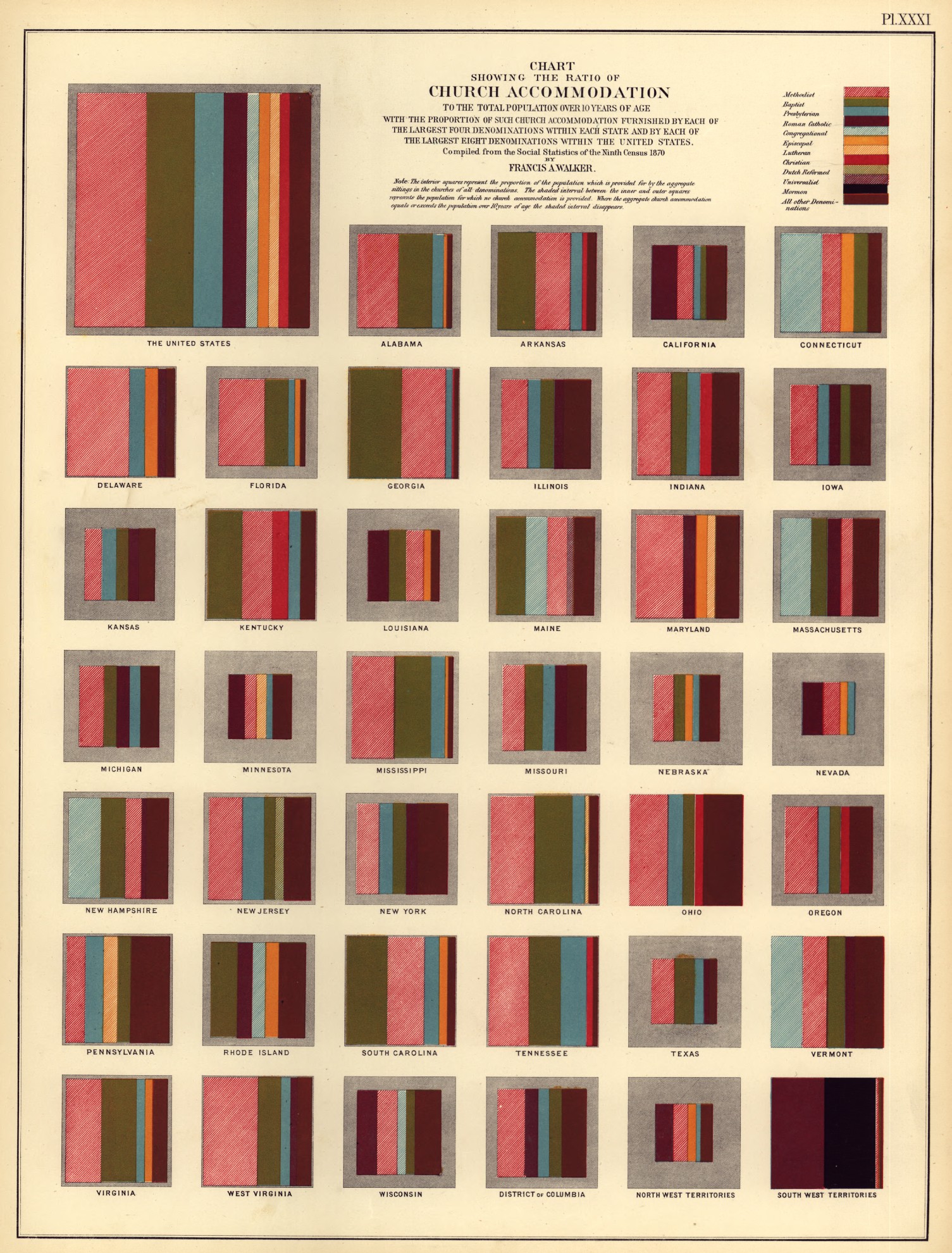
You wouldn’t expect to find such beauty in the Statistical Atlas of the United States, Based on the Ninth Census (1870) from the Library of Congress, would you? Sophisticated data visualizations, hand-calculated and hand-engraved, in beautiful colors, prepared by a staff headed by Francis A. Walker, M. A., superintedent of the ninth census.
The display above shows you, for each U. S. state and territory, the proportion of the church-going population (the colored boxes) relative to the total population (the shaded box in which the colored boxes are set), as well as the breakdown by the top 11 denominations!
The problem with wind energy is that it drives prices down! From Bloomberg news:
After years of getting government incentives to install windmills, operators in Europe may have become their own worst enemy, reducing the total price paid for electricity in Germany, Europe’s biggest power market, by as much as 5 billion euros some years, according to a study this week by Poeyry, a Helsinki-based industry consultant.
Jerome a Paris has an excellent discussion of the article over at The Oil Drum. He also links from there to an excellent (and entirely wonky) discussion of the proper pricing of wind power. It is a great article – one key takeaway is that wind power actually brings electricity prices down! Understanding that assertion requires a discussion of marginal costs, initial investments, demand curves, spot pricing, intermittency, externalities, and Spitzenlast (see above), but it’s totally worth it.
Another key point is that “market” pricing actually tilts the playing field toward fuel-based generation of electricity, because of its lower capital and debt-servicing requirements:
selecting market mechanisms to set electricity prices (rather than regulating them) is, again, not technology neutral: here as well, deregulated markets are structurally more favorable to fossil fuel-based generation sources than publicly regulated price environments.
So while I definitely wanted to highlight the issues around wind power (and point you to some excellent, informed commentary), I mostly just wanted an excuse to show that graph! SPITZENLAST!
Audio clip: Adobe Flash Player (version 9 or above) is required to play this audio clip. Download the latest version here. You also need to have JavaScript enabled in your browser.
“One of the traditional methods of imposing Statism or Socialism on a people has been by way of medicine. It’s very easy to disguise a medical program as a humanitarian project. Most people are a little reluctant to oppose anything that suggests medical care for people who possibly can’t afford it. Now, the American people, if you put it to them about Socialized Medicine and gave them a chance to choose, would unhesitatingly vote against it. We had an example of this: under the Truman Administration, it was proposed that we have a compulsory health insurance program for all people in the United States. And, of course, the American people unhesitatingly rejected this.”
This recording was distributed in 1961 as an LP, and was apparently funded by the American Medical Association. You can read all about it on Wikipedia!
President Obama is now out on tour daring the Republicans to try to repeal the new health care reform law. Here’s what he said yesterday:
“If they want to have that fight, we can have it. Because I don’t believe the American people are going to put the insurance industry back in the driver’s seat.”
Yeah, not after we worked so hard to shove the insurance industry aside, right? I mean, before the law passed, if you wanted to buy insurance, you paid whatever the Insurance industry demanded.
Whereas now, you will be obligated by law to give your money to a private insurance company, at whatever price they name, or else pay a tax penalty.
Yessirree Bob, we certainly wouldn’t want to let the insurance industry back in the driver’s seat! We showed them who’s boss!
…Now, to be fair: eliminating lifetime payout caps, limiting annual payout caps, and requiring the companies to accept customers regardless of pre-existing conditions are all good reforms. But there are currently no provisions for limiting the costs of insurance premiums! And, if you earn more than 400% of the Federal poverty limit, you receive NO FINANCIAL ASSISTANCE from the government (this year, the magic 400% number is about $43,000).
So, the government is mandating that you buy insurance, but they’re not setting limits on what the companies can charge for it.
I seem to remember one of the Presidential candidates opposing this idea… saying something about how it wouldn’t work, and it wasn’t fair… Now let me see, who was it again…?
Since 1997, every night before I go to sleep, I turn around three times and chant “on-gay iger-tay”. In more than thirteen years, I have not been attacked by a tiger. My method is perfect!
Everything I know about logic, reasoning, and causality, I learned from Peter Wehner, former deputy assistant to President Bush, in this op-ed:
In the aftermath of the 9/11 attacks, when virtually everyone assumed we’d be hit again, Bush put the United States on a war footing. He mobilized the entire federal government, including the military, Homeland Security, the Treasury, the FBI, our intelligence agencies and more.
We have not been attacked since.
Update 3/26/10:
I should add that I have also learned a great deal about logic and causality from former Bush administration speechwriter Marc Thiessen, from his fabulous new book Courting Disaster:
“In the decade before the C.I.A. began interrogating captured terrorists, Al Qaeda launched repeated attacks against America. In the eight years since the C.I.A. began interrogating captured terrorists, Al Qaeda has not succeeded in launching one single attack on the homeland or American interests abroad.”
Q.E.D., baby!
(BTW, the Thiessen quote comes from this excellent takedown by Jane Mayer in the current New Yorker magazine.)
J. Edgar Hoover, that is! Via BoingBoing, I came across The Kisseloff Collection, which is author Jeff Kisseloff’s collection of photos and stories stretching back through the 1920’s. Some of the photos are gorgeous, some are disturbing, and some are just weird:
Jeff writes about working with Alger Hiss in the early 1970’s, and in the process going through more than 40,000 pages of FBI files. He recalls many of the nasty, anti-Semitic writings he found in Hoover’s personal collection, and fires off this bon mot about the FBI director:
he had his agents compile lists of left-wingers to be picked up and placed in detention camps in the event of a national emergency. If he compiled lists of right-wingers it was only for dinner invitations.
…the masters of the American economy (and, thus, the people whose largely unaccountable decisions determine the material fortunes of most people in our country) don’t give a flying fuck about you, me, or anyone else we know:
“American business is about maximizing shareholder value,” said Allen Sinai, chief global economist at the research firm Decision Economics. “You basically don’t want workers. You hire less, and you try to find capital equipment to replace them.”
What a shame that the structure of our economic and political life is simply a force of nature that is immune to modification. If only there were some way to structure a society so that the primary economic activities were directed toward something else in addition to “maximizing shareholder value.”
Andrew Sullivan calls out Dick Cheney’s admission this weekend, “I was a big supporter of waterboarding,” and correctly notes that the former Vice President has thereby admitted to being guilty of a war crime. War Crimes must be investigated and prosecuted under U. S. law and international treaty, and the principle of Universal Jurisdiction applies (meaning, Cheney could be indicted and arrested by agents of a foreign government and held to account).
Of course, the Attorney General of the United States doesn’t seem to understand his solemn obligation:
[Attorney General Eric Holder] added that he had seen documents making clear that Cheney’s office was the driving force behind the Bush Administration’s most controversial counterterrorism policies, especially those sanctioning brutal interrogations. He said of Cheney, “I think he’s worried about what history’s judgment will be of the role that he played in making decisions about everything from black sites to enhanced interrogation techniques.”
Thanks, Eric Holder. Let’s all just sit on our hands and wait for history to render a judgment. It’s not like it’s your JOB to go around enforcing the laws of the United States!
so i guess the question is whether we have a really big choir preaching to itself, or if this kind of action really gets noticed and influences any kind of change.