Blocking banal content on the internet is a self-defeating proposition. It teaches people how to become dissidents – they learn to find and use anonymous proxies, which happens to be a key first step in learning how to blog anonymously. Every time you force a government to block a web 2.0 site – cutting off people’s access to cute cats – you spend political capital.
John Legend and The Roots have a new album out, and one of my favorite songs is “Compared To What.” I played it for some musician friends of mine, and one of them said, “Wow, this is a lot slower than the original!”
There ensued some discussion of “the original.” One person said Common (the hip hop artist); someone else said, “I thought it was from The Seventies.” After a visit to The Google, I found a wealth of information about this interesting, important song of protest, and its circuitous pop history.
Mark Anthony Neal, a music writer and professor at Duke University, gives the best breakdown of the song’s history in a March, 2003 article for Pop Matters. He notes that, indeed, Common did record a version of “Compared to What,” with the singer Mya. But the only lyrics from the original song that remain are, “Tryin’ to make it real, compared to what?” Everything else is a rap by Common that includes lines like “the real can’t be bought or sold.”
The irony (which you knew was coming)? The rapper was remaking Eugene McDaniels’s 1960’s-era anti-war song as part of a Coca-Cola marketing campaign called “Coca-Cola…Real:”
The original version of the song is a powerful example of black pop that wasn’t afraid, echoing Audre Lorde, to speak truth to power, an element sorely missing in contemporary black pop music.
Many of the so-called hip-hop generation’s artists have been remarkably silent, while Bush, Rumsfeld, Rice, and Powell march lockstep to war with Iraq. Thus it is terribly ironic that in the midst of major antiwar protests around the world, one of the most “conscious” of hip-hop artists [Common] referenced one of the great protest recordings in the pantheon of soul music to sell brown caffeinated fizz.
That remake of the song is particularly distasteful when you compare it to the most famous of the 60’s-era versions. You Tube user Dr. Greez had uploaded the classic recording of pianist Les McCann and saxophonist Eddie Harris doing “Compared to What” live at the 1969 Montreux Jazz Festival:
That version really cooks.
It’s interesting to hear John Legend and The Roots, who share enough of an affinity with Common that he appears elsewhere on the same album (Wake Up!), offer their take on this anti-war song. Unlike Common in the Coca-Cola ads, John Legend sings the original lyrics more or less as written. The Roots provides a much more stripped-down, slower base for the song. Overall, it’s a stirring version.
As we’re in the midst of two “overseas contingency operations” that continue to kill and maim on a daily basis, the potent protest lyrics of “Compared To What?” remain sadly relevant. John Legend, ?uestlove, and the Roots have taken a small step toward restoring the honor, and the power, of Eugene McDaniels’s original.
Have a listen below.
[audio:http://www.noiselabs.com/blog/audio/roots_what.mp3|titles=Compared to What|artists=John Legend and The Roots]
Friend of the blog Tim Anderson bubbles up in a New York Times article about Kombucha (a drink many NII bloggers were enjoying back in the mid-90’s thanks to Shwilly B!):
Kombucha’s popularity has also attracted home brewers. Tim Anderson, founder of a 3D printer technology company, moved from Boston to Berkeley, Calif., with his “mother” — passed on to him from a friend who got it, as the story goes, from gypsies in Russia.
Mr. Anderson, an advocate for all things do-it-yourself, made step-by-step kombucha brewing instructions complete with videos for Instructables.com (one of over 200 tutorials he has made on everything from tire sandals to wheelchair shopping carts). Nearly 60,000 people have viewed the kombucha guide to-date, according to the site’s page-view statistics.
“I’m surprised people would pay to get this stuff,” Mr. Anderson said. “The kind you can buy tastes vinegary and dry, whereas the one you can make yourself is so incredibly delicious.”
Mr. Anderson has given kombucha culture to dozens of friends and strangers. Recently he put out a call to get some back after he neglected his brew and let the fermented patty dry out. “You can’t go around saying you killed your mother,” he said. “It freaks people out.”
Posted in funny, local, media, odd, society|Comments Off on Tim Anderson Bubbles Up in the New York Times!
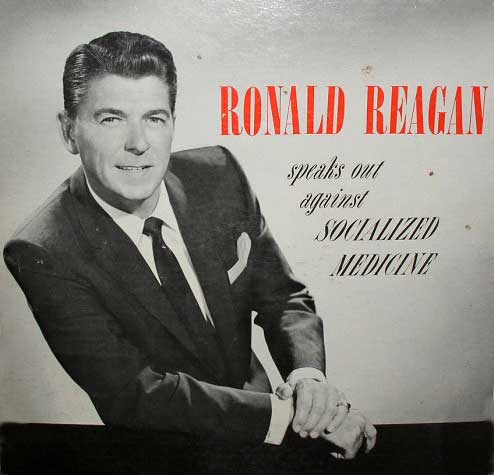
[audio:reagan-medicare.mp3|titles=Ronald Reagan Speaks Out Against Socialized Medicine]
“One of the traditional methods of imposing Statism or Socialism on a people has been by way of medicine. It’s very easy to disguise a medical program as a humanitarian project. Most people are a little reluctant to oppose anything that suggests medical care for people who possibly can’t afford it. Now, the American people, if you put it to them about Socialized Medicine and gave them a chance to choose, would unhesitatingly vote against it. We had an example of this: under the Truman Administration, it was proposed that we have a compulsory health insurance program for all people in the United States. And, of course, the American people unhesitatingly rejected this.”
This recording was distributed in 1961 as an LP, and was apparently funded by the American Medical Association. You can read all about it on Wikipedia!
That’s how iTunes showed the description for this week’s episode of This American Life. Stupidly funny.
For the record, the full description reads, “The story of how the American Psychiatric Association decided in 1973 that homosexuality was no longer a mental illness.”
Posted in funny, LGBTQ, media, silly|Comments Off on iTunes Crops Description, Chuckle Ensues