Peanuts Creep
Posted on January 22nd, 2012 at 1:12 pm by Steve
Earlier, we posted a children’s choir singing Radiohead’s “Creep” . Today, we came across (via Dangerous Minds) a different children’s choir version of “Creep,” this time, with video from the life of Charlie Brown.
VIDEO
Yo Dawg, I Heard You Like Xzibit Jokes…
Posted on November 17th, 2011 at 4:39 pm by Steve
It’s funny ‘cuz it’s a quine !
Or, is it?
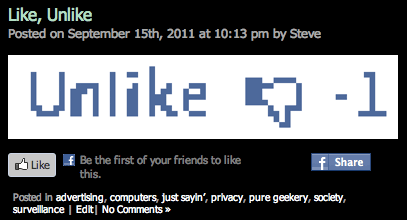
Like, “Like, Unlike”
Posted on September 15th, 2011 at 10:16 pm by Steve
totally .
The Uncanny Valley
Posted on June 15th, 2011 at 12:17 am by Steve
Oscilloscope Laboratories? Nitrous canisters? Liquid LSD in a breath mint bottle?
Why does this new Beastie Boys short film seem strangely familiar…?
On the Degradation of Language…
Posted on April 7th, 2011 at 3:25 pm by Steve
I can haz freedum?
Posted on February 4th, 2011 at 10:48 am by josh-wah
Blocking banal content on the internet is a self-defeating proposition. It teaches people how to become dissidents – they learn to find and use anonymous proxies, which happens to be a key first step in learning how to blog anonymously . Every time you force a government to block a web 2.0 site – cutting off people’s access to cute cats – you spend political capital.
Read the whole thing – it’s great.
Gratuitous lolcat inclusion:
Natural By Nature
Posted on January 2nd, 2011 at 4:18 pm by Steve
…I’m pretty sure ‘Nature’ didn’t collect a bunch of cow juice, stuff it into a steel can, and compress it with nitrous oxide.
Just sayin’.
Re: Re: Re: Re: Re: Re: Re: Missing Missy (with apologies to cat lovers)
Posted on July 14th, 2010 at 1:55 pm by dr.hoo
If any of you have lost a cat you know how upsetting it is. David Thorne responds with his own brilliant brand of snarky designer’s humor . (His whole site is full of hilarious email threads)
Posted in design , funny | Comments Off on Re: Re: Re: Re: Re: Re: Re: Missing Missy (with apologies to cat lovers)
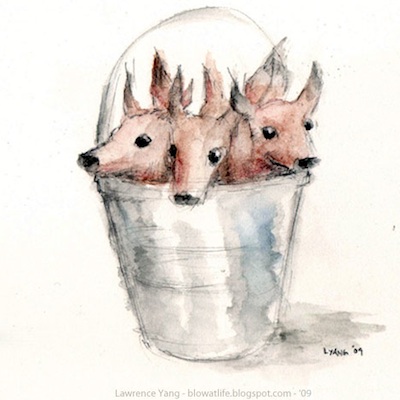
A Bare-Knuckled Bucket of Does
Posted on June 4th, 2010 at 2:11 pm by Steve
Lawrence Yang documents the obvious problem with Verizon’s $100 million integrated ad campaign for the Google/Droid phone. He was inspired by Nancy Friedman , who is a delight to read.
(Be sure also to read Nancy’s linked discussion of anthimeria , which is, loosely speaking, when someone verbs a noun.)
(Below: the actual $100 million ad campaign.)
“Glenn Beck has Nazi Tourette’s”
Posted on May 14th, 2010 at 12:11 am by Steve