Posted on September 15th, 2011 at 10:13 pm by Steve

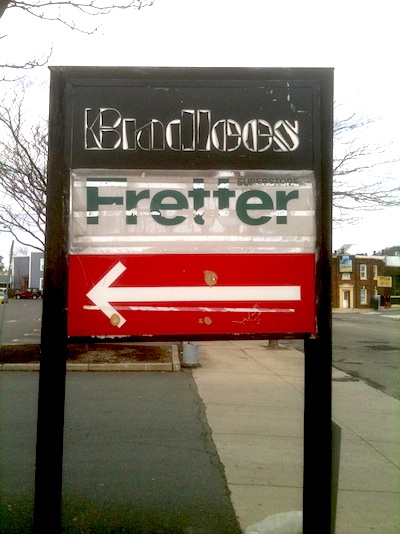
Spotted on Somerville Avenue next to McGrath Highway… once the haunt of Mrs. B and a long-departed Stop & Shop; later the home of electronics retailer Fretter; and, most recently, host to the lowest rung of the TJX retail hierarchy, the now-defunct A.J. Wright.
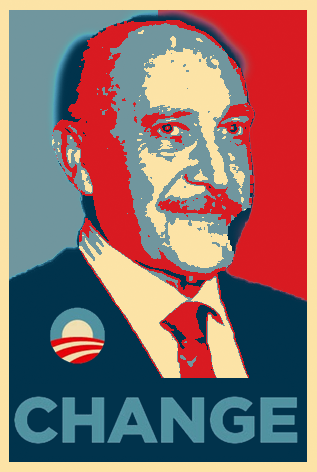
[S]ince 1993 [Omar] Suleiman has headed the feared Egyptian general intelligence service. In that capacity, he was the C.I.A.’s point man in Egypt for renditions—the covert program in which the C.I.A. snatched terror suspects from around the world and returned them to Egypt and elsewhere for interrogation, often under brutal circumstances.
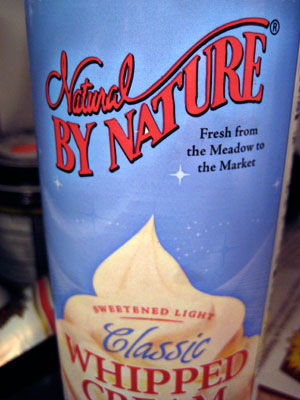
…I’m pretty sure ‘Nature’ didn’t collect a bunch of cow juice, stuff it into a steel can, and compress it with nitrous oxide.
Just sayin’.
John Legend and The Roots have a new album out, and one of my favorite songs is “Compared To What.” I played it for some musician friends of mine, and one of them said, “Wow, this is a lot slower than the original!”
There ensued some discussion of “the original.” One person said Common (the hip hop artist); someone else said, “I thought it was from The Seventies.” After a visit to The Google, I found a wealth of information about this interesting, important song of protest, and its circuitous pop history.
Mark Anthony Neal, a music writer and professor at Duke University, gives the best breakdown of the song’s history in a March, 2003 article for Pop Matters. He notes that, indeed, Common did record a version of “Compared to What,” with the singer Mya. But the only lyrics from the original song that remain are, “Tryin’ to make it real, compared to what?” Everything else is a rap by Common that includes lines like “the real can’t be bought or sold.”
The irony (which you knew was coming)? The rapper was remaking Eugene McDaniels’s 1960’s-era anti-war song as part of a Coca-Cola marketing campaign called “Coca-Cola…Real:”
The original version of the song is a powerful example of black pop that wasn’t afraid, echoing Audre Lorde, to speak truth to power, an element sorely missing in contemporary black pop music.
Many of the so-called hip-hop generation’s artists have been remarkably silent, while Bush, Rumsfeld, Rice, and Powell march lockstep to war with Iraq. Thus it is terribly ironic that in the midst of major antiwar protests around the world, one of the most “conscious” of hip-hop artists [Common] referenced one of the great protest recordings in the pantheon of soul music to sell brown caffeinated fizz.
[flvplayer http://www.noiselabs.com/blog/audio/mya_common_comparedToWhat.flv 400 320]
That remake of the song is particularly distasteful when you compare it to the most famous of the 60’s-era versions. You Tube user Dr. Greez had uploaded the classic recording of pianist Les McCann and saxophonist Eddie Harris doing “Compared to What” live at the 1969 Montreux Jazz Festival:
That version really cooks.
It’s interesting to hear John Legend and The Roots, who share enough of an affinity with Common that he appears elsewhere on the same album (Wake Up!), offer their take on this anti-war song. Unlike Common in the Coca-Cola ads, John Legend sings the original lyrics more or less as written. The Roots provides a much more stripped-down, slower base for the song. Overall, it’s a stirring version.
As we’re in the midst of two “overseas contingency operations” that continue to kill and maim on a daily basis, the potent protest lyrics of “Compared To What?” remain sadly relevant. John Legend, ?uestlove, and the Roots have taken a small step toward restoring the honor, and the power, of Eugene McDaniels’s original.
Have a listen below.
[audio:http://www.noiselabs.com/blog/audio/roots_what.mp3|titles=Compared to What|artists=John Legend and The Roots]
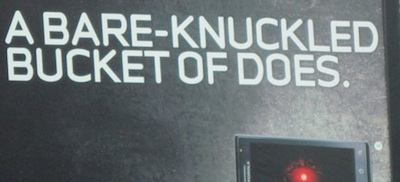
Lawrence Yang documents the obvious problem with Verizon’s $100 million integrated ad campaign for the Google/Droid phone. He was inspired by Nancy Friedman, who is a delight to read.
(Be sure also to read Nancy’s linked discussion of anthimeria, which is, loosely speaking, when someone verbs a noun.)
(Below: the actual $100 million ad campaign.)
An amazing/creepy visualization of what life might be like when we are “jacked in” to a virtual overlay 24/7. Lots of great little details in the animation. Note the sea of advertising that can be controlled, paying you more money per second depending on your environmental saturation.
The future looks AWESOME!
Augmented (hyper)Reality: Domestic Robocop from Keiichi Matsuda on Vimeo.
The latter half of the 20th century saw the built environment merged with media space, and architecture taking on new roles related to branding, image and consumerism. Augmented reality may recontextualise the functions of consumerism and architecture, and change in the way in which we operate within it.
A film produced for my final year Masters in Architecture, part of a larger project about the social and architectural consequences of new media and augmented reality.
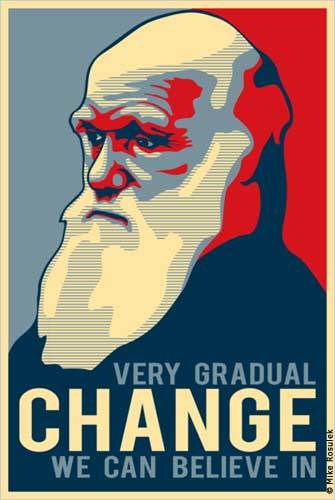
Okay, so maybe referring to The Obama as specious is a bit of a stretch, but, dammit, I wanted that pun! And, really, it was just a setup for this awesome graphic by artist Mike Rosulek:
Here’s a collection of silly protest signs of 2009. My favorite:

And, yes, it’s been a slow day at work.