Posted on January 29th, 2010 at 6:59 pm by Steve

“The idea is like grass. It craves light, likes crowds, thrives on crossbreeding, grows better for being stepped on.”
“The idea is like grass. It craves light, likes crowds, thrives on crossbreeding, grows better for being stepped on.”

Buckminster Fuller, in Critical Path (hello, Dr. Hoo!), answers a child’s query, “What is fire?”:
“Fire is the Sun unwinding from the tree’s log. The Earth revolves and the trees revolve as the radiation from the Sun’s flame reaches the revolving planet Earth. By photosynthesis the green buds and leaves of the tree convert that Sun radiation into hydrocarbon molecules, which form into the bio-cells of the green, outer, cambium layer of the tree. The tree is a tetrahedron that makes a cone as it revolves. The tree’s three tetrahedral roots spread out into the ground to anchor the tree and get water. Each year the new, outer-layer, green-tree cone revolves 365 turns, and every year the tree grows its new tender-green, bio-cell cone layer just under the bark and over the accumulating cones of previous years. Each ring of the many rings of the saw-cut log is one year’s Sun-energy impoundment. So the fire is the many-years-of-Sun-flame-winding now unwinding from the tree. When the log fire pop-sparks, it is letting go a very sunny day long ago, and doing so in a hurry.”

just thought this was an interesting way to get funding for a wacky project.
and a fairly simple framework to actually create… like “why didn’t we build this?”
i’ve heard of more useful permutations that connected small businesses around the world with backers. microfinance stuff. but this is just for silly fun stuff… like perhaps building the world’s largest kalimba sound system to promote world peace…

Some words from the late J.G. Ballard:
“People feel they can rely on the irrational. It offers the only guarantee of freedom from all the cant and bullshit and sales commercials fed to us by politicians, bishops and academics. People are deliberately re-primitivizing themselves. They yearn for magic and unreason, which served them well in the past, and might help them again. They’re keen to enter a new Dark Age. The lights are on, but they’re retreating into inner darkness, into superstition and unreason. The future is going to be a struggle between vast systems of competing psychopathologies, all of them willed and deliberate, part of a desperate attempt to escape from the rational world and the boredom of consumerism.”
“Our streets are the cable TV consumer channels. Our party insignia are the gold and platinum loyalty cards. Faintly risible? Yes, but people thought the Nazis were a bit of a joke. The consumer society is a kind of soft police state. We think we have choice, but everything is compulsory. We have to keep buying or we fail as citizens. Consumerism creates huge unconscious needs that only fascism can satisfy. In anything, fascism is the form that consumerism takes when it opts for elective madness. You can see it here already.” (page 105)
These three interlinked concepts of consumerism, mental illness, and fascism are woven through the entire narrative.
“Now. I see you as tomorrow’s man. Consumerism is the door to the future, and you’re helping open it. People accumulate emotional capital, as well as cash in the bank, and they need to invest those emotions in a leader figure. They don’t want a jackbooted fanatic ranting on a balcony. They want a TV host sitting with a studio panel, talking quietly about what matters in their lives. It’s a new kind of democracy, where we vote at the cash counter, not the ballot box. Consumerism is the greatest device anyone has invented for controlling people. New fantasies, new dreams and dislikes, new souls to heal. For some peculiar reason they call it shopping. But it’s really the purest kind of politics.” (page 145)
And in this dystopia, as with others you might know, the ugliest aspects of human behavior surface at a surprising rate.
“Who needs liberty and human rights and civic responsibility? What we want is an aesthetics of violence. We believe in the triumph of feelings over reason. Pure materialism isn’t enough, all those Asian shopkeepers with their cash-register minds. We need drama, we need our emotions manipulated, we want to be conned and cajoled. Consumerism fits the bill exactly. It’s drawn the blueprint for the fascist states of the future. If anything, consumerism creates an appetite that can only be satisfied by fascism. Some kind of insanity is the last way forward.” (page 168)
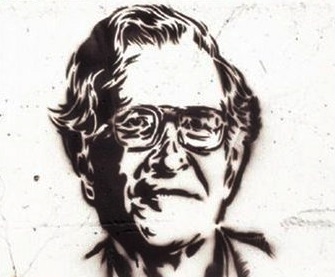
Radical Priorities, Pages 119-120:
In attempting to assess a new Administration in the United States, it is important to bear in mind the extraordinarily narrow spectrum of political discourse and the limited base of political power, a fact that distinguishes the United States from many other industrial democracies. The United States is unique in that there is no organized force committed to even mild and reformist varieties of socialism. The two political parties, which some refer to, not inaccurately, as the two factions of the single ‘Property Party,’ are united in their commitment to capitalist ideology and institutions. For most of the period since the Second World War, they have adhered to a ‘bipartisan foreign policy,’ which is to say, a one-party state as far as foreign affairs are concerned. The parties differ on occasion with regard to the role of the State, the Democrats generally tending to favor slight increases in state intervention in social and economic affairs, the Republicans tending to favor greater emphasis on private corporate power. Thus, under a Democratic Administration, there are likely to be some moves toward ‘welfare state’ policies along with a more aggressive foreign policy, as the State pursues a more interventionist program at home and abroad. But these distinctions between ‘liberals’ and ‘conservatives’ are only marginal in their significance and are at most slight tendencies rather than serious alternatives.
The domestic sources of power remain basically unchanged, whatever the electoral outcome. The major decision-making positions in the executive branch of the government, which increasingly dominates domestic and foreign policy, remain overwhelmingly in the hands of representatives of major corporations and the few law firms that cater primarily to corporate interests – thus representing generalized interests of corporate capitalism as distinct from parochial interests of one or another sector of the private economy. It is hardly surprising, then, that the basic function of the State remains the regulation of domestic and international affairs in the interest of the masters of the private economy, a fact studiously ignored in the press and academic scholarship, but apparent on investigation of the actual design and execution of policy over many years.
In fact, if some Administration were to depart in a significant way from the interests of highly concentrated private corporate power, its behavior would quickly be modified by a variety of simple techniques. Basic decisions concerning the health and functioning of the economy – hence social life in general – remain in the private sector. Decisions made in this realm set the conditions and define the framework within which the political process unfolds. By modifying the economic factors under their control, business interests can sharply constrain actions within the political sphere. But the issue rarely arises, since, as noted, the government, including those who manage the state sector of the economy, remains basically in the hands of private capital in any event.
Extra-governmental sources of ideas and programs are also, naturally, dominated by those who control the basic institutions of production, finance, and commerce.
He wrote those words in an article examining the prospects of an incoming Democratic Administration… in 1977.

But a man with a gun is told only that which people assume will not provoke him to pull the trigger. Since all authority and government are based on force, the master class, with its burden of omniscience, faces the servile class, with its burden of nescience, precisely as a highwayman faces his victim. Communication is possible only between equals. The master class never abstracts enough information from the servile class to know what is actually going on in the world where the actual productivity of society occurs. Furthermore, the logogram of any authoritarian society remains fairly inflexible as time passes, but everything else in the universe constantly changes. The result can only be progressive disorientation among the rulers. The end is debacle.
The schizophrenia of authoritarianism exists both in the individual and in the whole society.
I call this the Snafu Principle.
From Never Whistle While You’re Pissing, by Hagbard Celine.
(Celine is a fictional (?) character in the Illuminatus! Trilogy, by Bob Shea and Robert Anton Wilson. Celine’s treatise appears in the second book of the trilogy, The Golden Apple.)
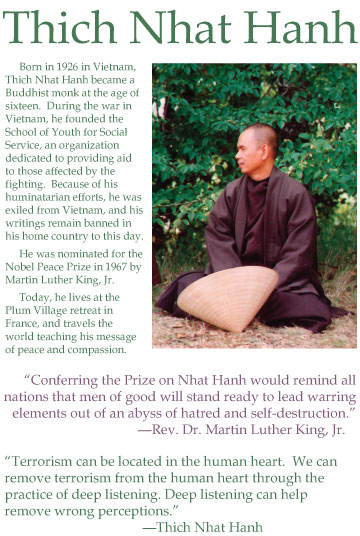
[Click above to download a PDF of this poster]
Rev. Dr. Martin Luther King, Jr. was so moved by [Thich] Nhat Hanh and his proposals for peace that he nominated him for the 1967 Nobel Peace Prize, saying, “I know of no one more worthy of the Nobel Peace Prize than this gentle monk from Vietnam.” Largely due to Thich Nhat Hanh’s influence, King came out publicly against the war at a press conference, with Nhat Hanh, in Chicago.
Thich Nhat Hanh is a true teacher:
Peace is present right here and now, in ourselves and in everything we do and see. The question is whether or not we are in touch with it. We don’t have to travel far away to enjoy the blue sky. We don’t have to leave our city or even our neighborhood to enjoy the eyes of a beautiful child. Even the air we breathe can be a source of joy.
We can smile, breathe, walk, and eat our meals in a way that allows us to be in touch with the abundance of happiness that is available. We are very good at preparing to live, but not very good at living. We know how to sacrifice ten years for a diploma, and we are willing to work very hard to get a job, a car, a house, and so on. But we have difficulty remembering that we are alive in the present moment, the only moment there is for us to be alive. Every breath we take, every step we make, can be filled with peace, joy, and serenity. We need only to be awake, alive in the present moment.
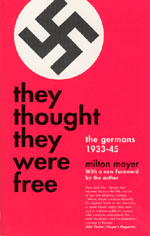
In 1952, the American scholar Carl Mayer, a Jewish man with German heritage, spent a year living and teaching in West Germany. He explains why in his Foreward (page xvii):
I wanted to see this monstrous man, the Nazi. I wanted to talk to him and to listen to him. I wanted to try to understand him. We were both men, he and I. In rejecting the Nazi doctrine of racial superiority, I had to concede that what he had been I might be; what led him along the course he took might lead me.
The book is devastating in the way that it speaks to us, today, in the United States.
Page 166:
“What no one seemed to notice,” said a colleague of mine, a philologist, “was the ever widening gap, after 1933, between the government and the people. Just think how very wide this gap was to begin with, here in Germany. And it became always wider. You know, it doesn’t make people close to their government to be told that this is a people’s government, a true democracy, or to be enrolled in civilian defense, or even to vote. All this has little, really nothing, to do with knowing one is governing.
“What happened here was the gradual habituation of the people, little by little, to being governed by surprise; to receiving decisions deliberated in secret; to believing that the situation was so complicated that the government had to act on information which the people could not understand, or so dangerous that, even if the people could understand it, it could not be released because of national security. And their sense of identification with Hitler, their trust in him, made it easier to widen this gap and reassured those who would otherwise have worried about it.
“This separation of government from people, this widening of the gap, took place so gradually and so insensibly, each step disguised (perhaps not even intentionally) as a temporary emergency measure or associated with true patriotic allegiance or with real social purposes. And all the crises and reforms (real reforms, too) so occupied the people that they did not see the slow motion underneath, of the whole process of government growing remoter and remoter.
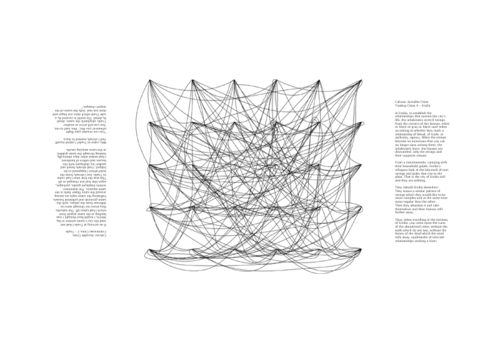
Marco Polo describes a bridge, stone by stone.
“But which is the stone that supports the bridge?” Kublai Khan asks.
“The bridge is not supported by one stone or another,” Marco answers, “but by the line of the arch that they form.”
Kublai Kahn remains silent, reflecting. Then he adds: “Why do you speak to me of the stones? It is only the arch that matters to me.”
Polo answers: “Without stones there is no arch.”
Invisible Cities, by Italo Calvino, 1972. Translated from the Italian by William Weaver, 1974.
Arguably one of Kurt Vonnegut’s greatest novels:
Pages 76-77:
“Mr. Constant,” he said, “right now you’re as easy for the Bureau of Internal Revenue to watch as a man on a street corner selling apples and pears. But just imagine how hard you would be to watch if you had a whole office building jammed to the rafters with industrial bureaucrats—men who lose things and use the wrong forms and create new forms and demand everything in quintuplicate, and who understand perhaps a third of what is said to them; who habitually give misleading answers in order to gain time in which to think, who make decisions only when forced to, and who then cover their tracks; who make perfectly honest mistakes in addition and subtraction, who call meetings whenever they feel lonely, who write memos whenever they feel unloved; men who never throw anything away unless they think it could get them fired. A single industrial bureaucrat, if he is sufficiently vital and nervous, should be able to create a ton of meaningless papers a year for the Bureau of Internal Revenue to examine.”
Page 163:
“The lieutenant colonel realized for the first time what most people never realize about themselves—that he was not only a victim of outrageous fortune, but one of outrageous fortune’s cruelest agents as well.”
Page 169:
The only controls available to those on board were two push-buttons on the center post of the cabin—one labeled on and one labeled off. The on button simply started a flight from Mars. The off button was connected to nothing. It was installed at the insistence of Martian mental-health experts, who said that human beings were always happier with machinery they thought they could turn off.
Page 176:
“Any man who would change the World in a significant way must have showmanship, a genial willingness to shed other people’s blood, and a plausible new religion to introduce during the brief period of repentance and horror that usually follows bloodshed.”
Pages 182-183:
“Their wish, when they died,” said Rumfoord, “was not for paradise for themselves, but that the brotherhood of mankind on Earth might be enduring.”
“To that end, devoutly to be wished,” said Rumfoord, “I bring you word of a new religion that can be received enthusiastically in every corner of every Earthling heart.”
“National borders,” said Rumfoord, “will disappear.”
“The lust for war,” said Rumfoord, “will die.”
“All envy, all fear, all hate will die,” said Rumfoord.
“The name of the new religion,” said Rumfoord, “is The Church of God the Utterly Indifferent.”
“The flag of that church will be blue and gold,” said Rumfoord. “These words will be written on that flag in gold letters on a blue field: Take Care of the People, and God Almighty Will Take Care of Himsef.”
“The two chief teachings of this religion are these,” said Rumfoord: “Puny man can do nothing at all to help or please God Almighty, and Luck is not the hand of God.”
Pages 216-217:
“You come and tell me the big news,” said Boaz. ” ‘Boaz—’ you say, ‘we’re going to be free!’ And I get all excited, and I drop everything I’m doin’, and I get set to be free.”
“And I keep saying it over to myself about how I’m going to be free,” said Boaz, “and then I try to think what that’s going to be like, and all I can see is people. They push me this way, then they push me that—and nothing pleases ’em, and they get madder and madder, on account of nothing makes ’em happy. And they holler at me on account of I ain’t made ’em happy, and we all push and pull some more.”
“And then, all of a sudden,” said Boaz, “I remember all the crazy little animals I been making so happy so easy with music. And I go find thousands of ’em lying around dead, on account of Boaz forgot all about ’em, he was so excited about being free. And every’ one of them lost lives I could have saved, if I’d have just kept my mind on what I was doing.”
“And then I say to myself,” said Boaz, ” ‘I ain’t never been nothing good to people, and people never been nothing good to me. So what I want to be free in crowds of people for?’ ”
“And then I knew what I was going to say to you, Unk, when I got back here,” said Boaz.
Boaz now said it:
“I found me a place where I can do good without doing any harm, and I can see I’m doing good, and them I’m doing good for know I’m doing it, and they love me, Unk, as best they can. I found me a home.”
“And when I die down here some day,” said Boaz, “I’m going to be able to say to myself, ‘Boaz—you made millions of lives worth living. Ain’t nobody ever spread more joy. You ain’t got an enemy in the Universe.’ ” Boaz became for himself the affectionate Mama and Papa he’d never had. ” ‘You go to sleep now,’ ” he said to himself, imagining himself on a stone deathbed in the caves. ” ‘You’re a good boy, Boaz,’ ” he said. ” ‘Good night.’ “
Pages 279-280:
Once upon a time on Tralfamadore there were creatures who weren’t anything like machines. They weren’t dependable. They weren’t efficient. They weren’t predictable. They weren’t durable. And these poor creatures were obsessed by the idea that everything that existed had to have a purpose, and that some purposes were higher than others.
These creatures spent most of their time trying to find out what their purpose was. And every time they found out what seemed to be a purpose of themselves, the purpose seemed so low that the creatures were filled with disgust and shame.
And, rather than serve such a low purpose, the creatures would make a machine to serve it. This left the creatures free to serve higher purposes. But whenever they found a higher purpose, the purpose still wasn’t high enough.
So machines were made to serve higher purposes, too.
And the machines did everything so expertly that they were finally given the job of finding out what the highest purpose of the creatures could be.
The machines reported in all honesty that the creatures couldn’t really be said to have any purpose at all.
The creatures thereupon began slaying each other, because they hated purposeless things above all else.
And they discovered that they weren’t even very good at slaying. So they turned that job over to the machines, too. And the machines finished up the job in less time than it takes to say, “Tralfamadore.”
Page 294:
At first glance, the laboratory-gowned scientist seemed to be a perfect servant of nothing but truth. At first glance, one was convinced that nothing but truth could please him as he beamed at his test tube. At first glance, one thought that he was as much above the beastly concerns of mankind as the harmoniums in the caves of Mercury. There, at first glance, was a young man without vanity, without lust—and one accepted at its face value the title Salo had engraved on the statue, Discovery of Atomic Power.
And then one perceived that the young truth-seeker had a shocking erection.
Page 302:
“Whatever we’ve said, friends, we’re saying still—such as it was, such as it is, such as it will be.”
Page 320:
“You finally fell in love, I see,” said Salo.
“Only an Earthling year ago,” said Constant. “It took us that long to realize that a purpose of human life, no matter who is controlling it, is to love whoever is around to be loved.”