Posted on November 13th, 2008 at 1:21 pm by Steve

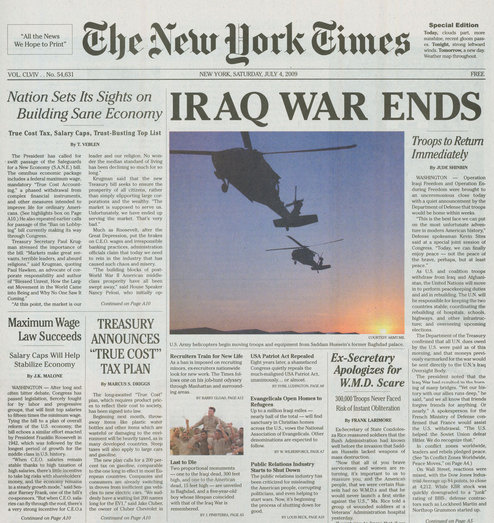
IRAQ WAR ENDS and other great headlines in today’s (fake) New York Times (courtesy of The Yes Men).

IRAQ WAR ENDS and other great headlines in today’s (fake) New York Times (courtesy of The Yes Men).

Seriously. We’ve been hearing for years that Americans need to curb their excessive consumption habits. We’ve been told that we drive too many cars, we use too much electricity, we throw away too much plastic, we import too much oil, and on and on and on.
Suddenly, we’re using less oil; we’re driving fewer miles; we’re buying fewer cars; we’re buying fewer goods; and we’re using less electricity. But this is all being reported as “bad” news!
We obviously are in desperate need of new ways to measure economic and social well-being. It shouldn’t be a headline crisis when U.S. auto sales drop 50%, it should be a sign of much-needed progress!
Spending and growth are not the measures of a healthy and satisfying life. I’ve been thinking about this stuff a lot since I read Bill McKibben’s Deep Economy. I’ll do a “dogeared” post on it soon…
“[Oil company] reports record profits…”
That headline ran today. It also ran in July, 2008. According to my search of the New York Times archives (oil AND record AND (profit OR profits)), it also ran in April, 2008. It also ran in February, 2008. It also ran in February, 2007. It also ran in July, 2006. It also ran in January, 2006. It also ran in October, 2005. It also ran in August, 2005. It also ran in February, 2005. It also ran in August, 2004. It also ran in July, 2004. It also ran in October, 2000. It also ran in July, 2000. It also ran in May, 1997. It also ran in January, 1997. It also ran in January, 1990. It also ran in October, 1988.
It’s funny. I guess if you control the supply of something vital to every sector of the economy, and there’s no limit on your pricing power (other than “the market”), then you can pretty much guarantee you’ll earn a shitload of money.
Here’s the relevant graf from 11 years ago:
Exxon, the largest oil company in the United States, said its profit jumped nearly 49 percent to a record $2.49 billion, or $2 a share, in the fourth quarter, compared with a profit of $1.68 billion, or $1.35 a share, in the similar quarter of 1995. Revenue climbed to $37.62 billion from $31.50 billion.
And here’s the word today:
Exxon Mobil Corp.’s third-quarter net income rose 58% to a new record of nearly $15 billion… Exxon Mobil said it earned $14.83 billion, or $2.86 a share, up from $9.41 billion, or $1.70 a share in the year-ago period.
Those are quarterly profits, not gross receipts. That’s a profit rate of almost $2,000 per second!
I also enjoyed finding this little nugget in an April 27, 1986 article in the New York Times:
President Reagan urged the repeal of the ”windfall profits” tax on domestic oil in an attempt to help out those companies hit by the price drop.
That tax was repealed on August 23, 1988, and has not been reinstated – although oil prices, which were around $38/barrel in 1980 and had fallen below $20/barrel in 1988, peaked above $140/barrel this summer.

Food writer Michael Pollan has a terrific article in last week’s New York Times Magazine, where he outlines the food-related policy challenges facing the incoming U.S. president. In his opening, he notes a startling fact about the energy consumed in the industrial agriculture process:
chemical fertilizers (made from natural gas), pesticides (made from petroleum), farm machinery, modern food processing and packaging and transportation have together transformed a system that in 1940 produced 2.3 calories of food energy for every calorie of fossil-fuel energy it used into one that now takes 10 calories of fossil-fuel energy to produce a single calorie of modern supermarket food. Put another way, when we eat from the industrial-food system, we are eating oil and spewing greenhouse gases. This state of affairs appears all the more absurd when you recall that every calorie we eat is ultimately the product of photosynthesis — a process based on making food energy from sunshine. There is hope and possibility in that simple fact.
I think his point would be clearer if he kept his numbers in the same order, though, like this: in 1940, the system produced 2.3 calories of food energy for every calorie of fossil-fuel energy used; today, it produces 0.1 calorie of supermarket food energy for every calorie of fossil-fuel energy used.

The New York Times, June 19, 2008:
Four Western oil companies are in the final stages of negotiations this month on contracts that will return them to Iraq, 36 years after losing their oil concession to nationalization as Saddam Hussein rose to power.
Exxon Mobil, Shell, Total and BP — the original partners in the Iraq Petroleum Company — along with Chevron and a number of smaller oil companies, are in talks with Iraq’s Oil Ministry for no-bid contracts to service Iraq’s largest fields.
The New York Times, June 30, 2008:
A group of American advisers led by a small State Department team played an integral part in drawing up contracts between the Iraqi government and five major Western oil companies to develop some of the largest fields in Iraq, American officials say.
The disclosure, coming on the eve of the contracts’ announcement, is the first confirmation of direct involvement by the Bush administration in deals to open Iraq’s oil to commercial development and is likely to stoke criticism…
At a time of spiraling oil prices, the no-bid contracts, in a country with some of the world’s largest untapped fields and potential for vast profits, are a rare prize to the industry…
A potential area of criticism, however, is that only Western companies got the bigger oil contracts. In particular, Russian companies that have experience in Iraq and had sought development contracts are still waiting.
British Prime Minister Tony Blair, February 6, 2003:
No, let me just deal with the oil thing because this is one of the… we may be right or we may be wrong, I mean people have their different views about why we’re doing this thing.
But the oil conspiracy theory is honestly one of the most absurd when you analyse it.
The fact is that, if the oil that Iraq has were our concern I mean we could probably cut a deal with Saddam tomorrow in relation to the oil.
It’s not the oil that is the issue, it is the weapons.
NY Times has and interesting story on folks stealing rancid cooking oil from restaurants. Thieves include “do-it-yourself environmentalists worried about their carbon footprints, warring waste management firms trying to beat each other on the sly, and petty thieves who are profiting from the oil’s rising value on the black market.”

“Fryer grease has become gold,” Mr. Damianidis said. “And just over a year ago, I had to pay someone to take it away.”
Much to the surprise of Mr. Damianidis and many other people, processed fryer oil, which is called yellow grease, is actually not trash. The grease is traded on the booming commodities market. Its value has increased in recent months to historic highs, driven by the even higher prices of gas and ethanol, making it an ever more popular form of biodiesel to fuel cars and trucks.
In 2000, yellow grease was trading for 7.6 cents per pound. On Thursday, its price was about 33 cents a pound, or almost $2.50 a gallon. (That would make the 2,500-gallon haul in the Burger King case worth more than $6,000.)
The Big Picture has an interesting article on how the US energy policy has worked to drive up the price of oil.
It turns out that for the past 3 decades, we’ve had a George Costanza Energy policy — every decision we have made as a country has worked to drive energy prices higher. Had we made the opposite decisions, Crude Oil prices would be much lower than they are today ($130.17 as I type this).
What follows is a list of energy-related policies of the United States. On many of these, I have no opinion — but I wanted to list as many as I could to demonstrate why Oil is where it is
US Policies with an impact on Energy:
1. Limited areas available for offshore drilling;
2. Stopped the rise of CAFE standards for automobiles;
3. Restricted nuclear power generation of Electrical;
4. Federal Reserve policies since 2001 led to a very weak US dollar (raising Oil prices);
5. Energy conservation policies? None
6. Iraq and Afghanistan wars contributing to Middle East tensions
7. No major United States funding for R&D on energy;
Chris Pummer at Market Watch comments on why $8 gas might not be so bad in the long run.
Americans should be celebrating rather than shuddering over the arrival of $4-a-gallon gasoline. We lived on cheap gas too long, failed to innovate and now face the consequences of competing for a finite resource amid fast-expanding global demand.
Just took a small photography gig working on a project for Chevron. The day I started working on the project I read that Chevron reported $5 billion in profits for the first quarter of 2008. Looking at the $4 gas prices at the pump my first reaction was one of disgust, for Chevron’s apparent greed, and myself for working for them. It seemed pretty obvious that someone was making out like a bandit, a blatant case of price gouging by a greedy multinational corporation at the expense of the average american.
Then a friend sent me an article published today on Salon.com that breaks down the price of gas and it seems it’s not so simple. While Chevron is making record profits for drilling oil, there profits from refining and retail sales are actually down from last year.
According to the article, Chevron is not really responsible for price gouging because they don’t actually set the prices for crude:
In 2008, Chevron recorded its largest first-quarter profit ever: $5.17 billion. But according to the San Francisco Chronicle, Chevron’s profits from refining and selling gasoline in the United States were actually down 99 percent in the first quarter of 2008 from a year earlier, and “during the previous two quarters, the company actually lost money making gas.” That $5 billion in profits is derived primarily from extracting the oil out of the ground and selling it on the open market where prices are set.
The knee-jerk liberal in me wants to look at gas prices and blame the greedy corp. What the article concludes is that the real problem is the worldwide addiction to oil and the growing demand.
Hmmm, I did drive to the Chevron photo shoot even though it’s only 3 miles from my house.
p.s. Got this shot of a great remix of their carwash sign:

p.p.s. NYTimes just ran a story on how many gas pumps dials are burning out from rolling so fast and that many price read outs aren’t designed to go over $3.99. They are having to result to charging by the half gallon.