Posted on November 17th, 2011 at 4:39 pm by Steve

Who Watches the (Weather) Watchmen?
Posted on April 13th, 2011 at 5:51 pm by Steve
Posted on April 13th, 2011 at 5:51 pm by Steve
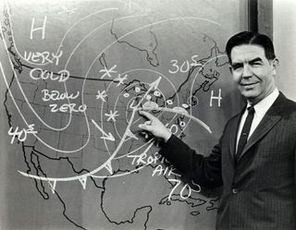
I’ve long wanted to keep records of weather forecasts and compare them to actual results. But, I’m too lazy.
Fortunately, Forecast Advisor has started to do that for us! And, it turns out that my suspicions were correct.
At least for Boston, the weather forecasts are less than 80% accurate. Now, consider that these data are looking at just the 1-3 days ahead forecasts, and in fact are collapsing the data. The day-ahead forecasts are usually more accurate than the 3-days ahead forecasts. The company sells a data feed that I’m sure drills down to this level and beyond.
But consider: for March 2011, the National Weather Service predicted the high temperature within 3° F of the actual high temperature only 40% of the time! They accurately predicted the low temperature +/- 3° 53% of the time in March. They did slightly better with their precipitation forecasts – if they called for rain or snow, they were right about 83% of the time.
Over the past year, they did better on temperature predictions (63% right on the highs, 70% right on the lows) but worse on the precipitation calls (75% accurate).
What can we conclude? National Weather Service forecasts are better than chance… but not by a lot. Turns out, you don’t need a Weatherman to know which way the wind blows…
Tracking Michael
Posted on October 1st, 2010 at 3:04 am by dr.hoo
Posted on October 1st, 2010 at 3:04 am by dr.hoo

Sifting through a bunch of data viz projects for a project I’m working on. Came across this one that is like no other I’ve seen yet.
On May 4th, 2007, we asked internet users to help isolate Michael Jackson’s white glove in all 10,060 frames of his nationally televised landmark performance of Billy Jean. 72 hours later 125,000 gloves had been located. wgt_data_v1.txt (listed below) is the culmination of data collected. It is released here for all to download and use as an input into any digital system. Just as the data was gathered collectively it is our hope that it will be visualized collectively. Please email links to your apps, video, source code, and/or screen shots to evan[at]eyebeam[dot]org. Work will be exhibited in an online gallery and depending on popularity and interest potentially in a forthcoming physical gallery exhibition as well. Huge thanks to everyone that contributed to the data collection.
Be sure and watch the video to see some of the crazy and not so crazy uses for all that tracking data.
Visualizing Empire
Posted on October 1st, 2010 at 2:22 am by dr.hoo
Posted on October 1st, 2010 at 2:22 am by dr.hoo
Pedro M Cruz’s visual history of European empires of the 19th and 20th centuries:
Built in Processing. More on the project HERE.
Augmented City 3D
Posted on September 28th, 2010 at 3:14 pm by dr.hoo
Posted on September 28th, 2010 at 3:14 pm by dr.hoo
Another cool AR simulation from Keiichi Matsuda: Augmented City 3D. Lots of cool motion tracking.

More on his site here.
via io9
“I Watched the Sun Set, Listening to the Colors Change…”
Posted on September 20th, 2010 at 4:08 pm by Steve
Posted on September 20th, 2010 at 4:08 pm by Steve
Austin Seraphin (who is nearly blind) describes the revelation of using an iPhone with Voice Over functionality:
I spent ten minutes looking at my pumpkin plants, with their leaves of green and lemon-ginger. I then roamed my yard, and saw a blue flower. I then found the brown shed, and returned to the gray house. My mind felt blown. I watched the sun set, listening to the colors change as the sky darkened.
It’s inspiring that the Apple engineers and developers are working hard to make their devices and software accessible to the widest possible number of people.
Knobs and Dials – Yummy!!!!
Posted on September 6th, 2010 at 1:43 pm by dr.hoo
Posted on September 6th, 2010 at 1:43 pm by dr.hoo
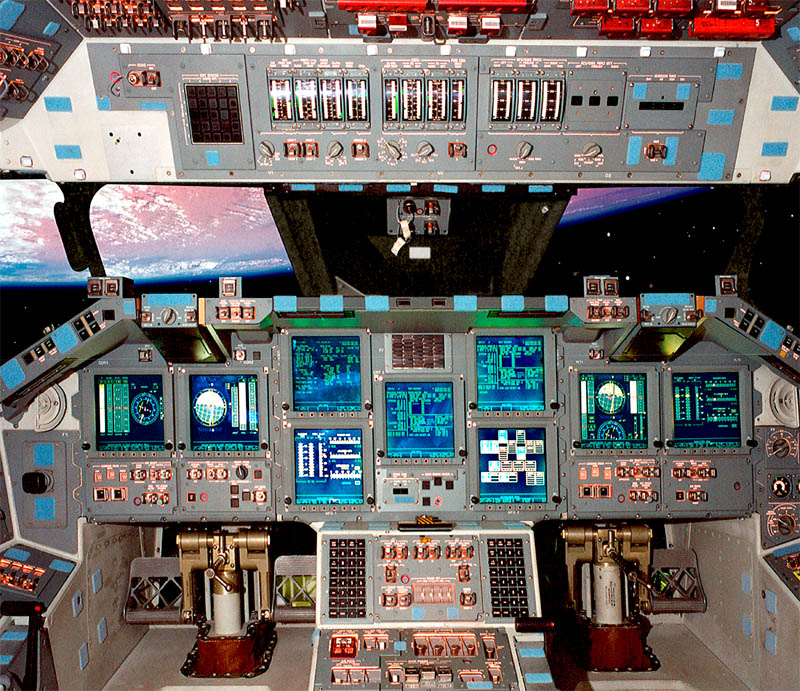
You know how dun like dem knobs and dials. Dark Roasted Blend has an awesome collection of the,
Including this virtual cockpit of the Space Shuttle:
Authority, Control, and Trust in Human-Machine Systems
Posted on May 13th, 2010 at 1:58 pm by Steve
Posted on May 13th, 2010 at 1:58 pm by Steve
Automated systems in aircraft reduce some risks at the cost of increasing other risks. Incorrect or inconsistent applications of automation to complex human-machine systems can have unexpected and even deadly consequences.
NASA Ames Research facility has done a lot of thinking about the proper ways to design these systems. Dr. Charles Billings, in particular, has published a number of excellent papers on the subject. Here’s an excerpt from his 1995 paper, “Human-Centered Aviation Automation: Principles and Guidelines”, where he asks (and answers) a fundamental design question:
If the human operator cannot effectively oversee and retain management authority over his tools, he has lost authority over the entire operation. Will this be a tenable situation?
I believe it comes down to a matter of trust. Will we provide pilots with full authority, train them carefully, and trust them to do “the right thing”, whatever it is in particular circumstances? Or will we circumscribe pilot authority by making it impossible to damage the airplane, and in the process perhaps make it impossible to use its ultimate capabilities if they really need them…? My bias, based on a number of cases in which pilots have been able to recover from extreme emergencies, and other cases in which they did not recover but could have had they used all available resources, is that command authority should be limited only for the most compelling reasons, and only after extensive consultation with both test and line pilots or controllers at “the sharp end” of the system.
Boeing and Airbus, the world’s largest manufacturers of transport aircraft, seem to draw the “compelling reasons” line in different places. Under the Airbus computers’ “Normal Law” operating mode, the pilots cannot command inputs that would cause the airplane to enter an dangerous condition (for instance: they cannot stall the plane by increasing the angle of attack without adding thrust; the computer will prevent a stall from happening). Whereas Boeing’s approach is to make dangerous conditions increasingly difficult to cause (for instance: the Boeing’s control column will provide increased resistance against a pilot who is about to stall the airplane, making it physically more difficult for the pilot to cause this condition, but still allowing the possibility).
This continues to be an area of active study and discussion throughout the aviation community, and it has broader application as we interact more often with complex machine-controlled systems. Many pilots decry the apparent loss of airmanship due to the increase in cockpit automation.